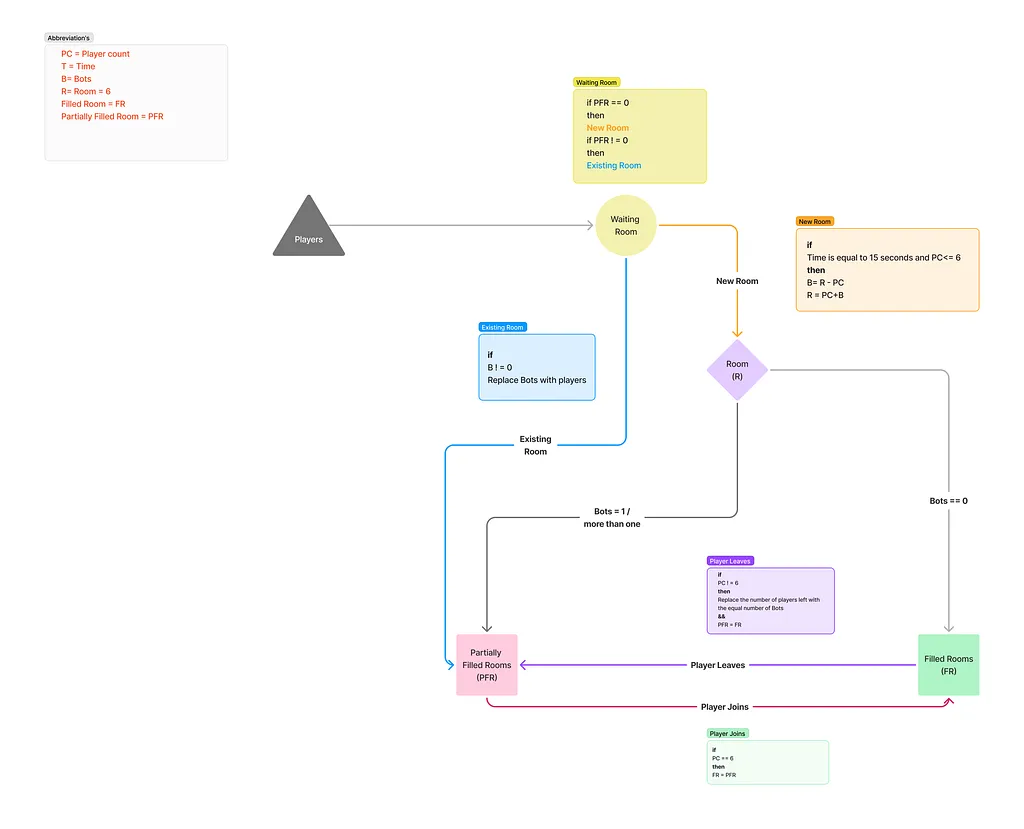
In multiplayer games like Blackjack, creating a seamless and efficient lobby system is critical to ensuring a smooth player experience. Here’s a breakdown of the dynamic lobby system designed specifically for a 6-player Blackjack game.
Key Objectives:
- Minimize player wait times by filling rooms quickly through dynamic room management, prioritizing partially filled rooms, and using bots to immediately fill gaps when human players are unavailable.
- Ensure every room has the optimal number of players (6) before starting a game. If the optimal number isn’t reached within the set timeframe, bots are added to fill the remaining slots, allowing the game to proceed without delays.
- Dynamically manage player departures and entries using bots to maintain room integrity and ensure uninterrupted gameplay.
Core Features of the Lobby System
Abbreviations
To simplify the logic, the following abbreviations are used:
- PC: Player Count
- T: Time
- B: Bots
- R: Room
- FR: Filled Room
- PFR: Partially Filled Room
Flow Overview
1. Players Enter the Lobby
The system starts with players entering the lobby. Depending on the state of existing rooms, players are directed to either:
- Partially Filled Rooms (PFR): Rooms with fewer than 6 players.
- New Rooms: If no PFR exists.
2. Waiting Room
- If there are no PFRs available (PFR = 0):
- A new room is created.
- If PFRs exist (PFR ≠ 0):
- Players are redirected to these existing rooms.
3. New Room Creation
- A new room is created if there are no suitable PFRs.
- Logic for new rooms:
- If T = 15 seconds and PC < 6:
- Bots are added to fill the remaining slots. These bots are programmed to mimic real player behavior by employing strategies, decision-making patterns, and response times that align with human gameplay, ensuring the game’s quality and challenge are preserved.
- B = 6 — PC
- The room composition becomes R = PC + B.
4. Existing Rooms
- Rooms that already have players but are not yet full dynamically replace bots with real players as they join.
- Example: If B > 0, bots are replaced by real players until the room is full.
5. Partially Filled Rooms (PFR)
- These rooms maintain a balance of players and bots.
- When players join or leave:
- Bots are added or removed to keep the game flow consistent. If multiple rooms require bots, priority is given to rooms that are closest to being filled, ensuring efficient resource allocation and maintaining gameplay momentum.
6. Player Joins
- When a player joins:
- PC++: Player count increases.
- Bots are adjusted to ensure the room is either filled or transitions to a filled room.
7. Player Leaves
- When a player leaves:
- PC — : Player count decreases.
- A bot replaces the player to maintain the room’s integrity.
8. Filled Rooms (FR)
- A room is considered “filled” when it contains 6 players and no bots (B = 0)
- Once filled, the game starts.
Dynamic Room Management
The system dynamically adapts to player behavior:
- New Players: Join partially filled rooms or create new rooms if necessary.
- Bots: Fill empty slots to prevent excessive wait times.
- Timed Logic: Ensures rooms are filled within 15 seconds to maximize engagement.
Industry Comparison
Compared to other lobby systems in the industry, this approach focuses on leveraging bots not just as placeholders but as dynamic participants. These bots ensure minimal disruption to gameplay, provide a seamless transition when real players join, and uphold game quality through realistic behavior.
Why This System Works
- Reduced Wait Times: By using bots, players are guaranteed minimal waiting, as games start even if the lobby isn’t full.
- Smooth Transitions: The system dynamically replaces bots with real players, ensuring a seamless experience.
- Flexibility: The logic allows for easy scaling and adjustments based on the player base.
- Game Quality: Bots mimic real player behavior, ensuring that gameplay remains challenging and engaging.
Conclusion
This lobby system is designed to enhance the multiplayer experience for a 6-player Blackjack game by striking a balance between automation (bots) and real player interaction. With minimal wait times, dynamic room management, and intelligent bot integration, this system ensures players remain engaged and entertained while maintaining the high standards expected in competitive multiplayer environments.