I Got Tired of Picking Libraries by Vibes: So I Built an AI Agent Skill That Scores Them, Then Taught It to Smell a Maintainer Hand off
Every time I needed a library (a job queue, a vector DB, an auth layer), I’d lose an hour to Reddit threads and blog posts from 2021, then pick whatever had the most GitHub stars and hope for the best.
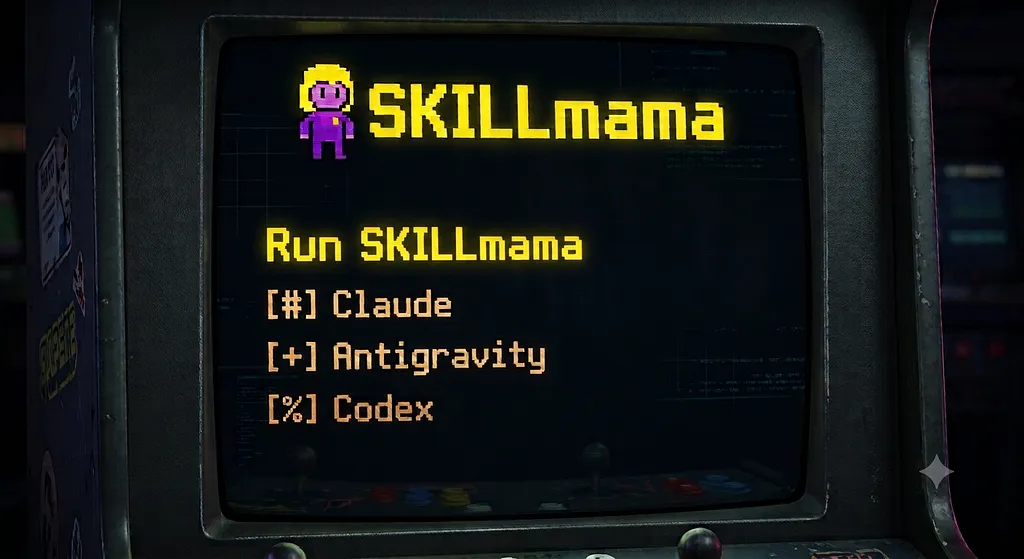
So I built SKILLmama, a skill that works across Claude Code, Claude.ai, OpenAI Codex, and Antigravity. This post covers where it started and where it’s gone since, including a change that came from an unexpected place: a Mastodon reply.
The Problem: Star Counts Aren’t a Decision
“Most stars” tells you a library was popular at some point. It doesn’t tell you whether it fits your stack, whether it’s still maintained, or whether it’s simple enough to not become its own liability. I wanted something that reasoned about the actual tradeoff instead of handing me a confident one-word answer.
What SKILLmama Does
You type `/skillmama find me a job queue` and it:
- Scans your project files to detect your actual stack
- Asks one constraint question if you didn’t give any (self-hosted? open-source? free tier?)
- Searches five tiers: GitHub, MCP servers, npm/PyPI, templates, and agent skills
- Scores every candidate on a fixed formula: Compatibility 40% / Popularity 30% / Maintenance 15% / Simplicity 15%
- Runs a security gate that drops anything with known CVEs or hidden data exfiltration
- Returns a ranked top 3 with the math shown: stars, weekly downloads, last commit date, install command, links
The part I actually wanted out of this project: it shows why 1 beat 2, instead of just asserting it.
Run `/skillmama` with no arguments and it flips around: scans your project, finds capability gaps you haven’t filled (no auth? no rate limiting on those OpenAI calls?), and asks what you want to tackle first.
It’s Apache 2.0, no signup, no telemetry.
Install (any agent, via skills CLI):
npx skills add Magithar/SKILLmama
Claude Code specifically:
npx skills add Magithar/SKILLmama -a claude-code
(The flag matters: without it, the install can silently fail to register the slash command.)
Antigravity (manual copy, confirmed working):
mkdir -p ~/.gemini/config/skills/skillmamacp skillmama/SKILL.md ~/.gemini/config/skills/skillmama/
Restart Antigravity, then invoke explicitly: type `/`, select SKILLmama, and ask your capability question.
(Note: `npx skills add Magithar/SKILLmama -a antigravity` installs but to the wrong path, Antigravity won’t read it there. Use the manual copy above until the CLI is fixed.)
https://medium.com/media/327dac145a91acac524af82017c93b59/href
Repo: github.com/Magithar/SKILLmama
I closed that post asking for feedback on the scoring weights: 40/30/15/15 was a gut call, not a derived one. What came back wasn’t about the weights at all.
The Reply That Changed the Roadmap
Sixteen days after that first post, someone replied on Mastodon with a line that stuck with me: Known maintainer hand-off’s predict trouble more reliably than known CVEs do, and nothing checks for that.
They were right, and it was the kind of signal a CVE database structurally can’t capture: a CVE tells you a vulnerability was found. A handoff tells you the trust relationship underneath the package changed, which is the moment worth watching, not the moment something breaks.
So I built it: v1.4.6 adds a hand-off check.
What It Does
The hand-off check flags when npm publish rights moved from one person to a different person in the last 12 months. It’s not an auto-block, just a warning that names both publishers and the date. A hand-off alone proves nothing; plenty of legitimate projects change hands. But it’s exactly the kind of thing you want surfaced, not buried.
Testing It Against a Real Incident
To validate this wasn’t just theatre, I tested it point-in-time against the 2018 event-stream incident: the case where a compromised npm maintainer shipped a Bitcoin-wallet stealer hidden inside a popular dependency.
The check fires on 2018–10–01, about eight weeks before the malicious code was publicly disclosed on 2018–11–26.
Across a 98-package sweep of popular npm libraries, it fires on 7.1% of them. That’s tight enough that when it does fire, it’s actually worth reading, not just noise you learn to ignore.
The CVE Gate Also Got Rebuilt
The old CVE rule just said “has a known CVE.” No data source was named, which in retrospect wasn’t good enough to trust blindly. That’s gone. The gate now queries OSV.dev live against the exact version being recommended, across npm, PyPI, Go, and crates.io. Blocks now quote the advisory’s actual trigger condition instead of a bare “no.”
Known Limits (Stated Up Front, Not Buried in the Docs)
- The hand-off check is npm only. PyPI has no per-release uploader identity, so there’s currently no equivalent signal to check there.
- It catches hand-off’s, not account takeovers under the real maintainer’s name. Those are a different threat model and need a different check.
Where It Stands Now
Still Apache 2.0. Still no signup. Still no telemetry. And it still leans on a capable model: Sonnet or better gives noticeably better rankings than a small model, especially on the tradeoff reasoning, less so on the mechanical parts of the scoring.
If you try it, I’m still genuinely curious about two things: whether 40/30/15/15 is the right weighting for your stack, and whether there are other “obvious in hindsight” signals like the hand-off check that nothing currently watches for.